
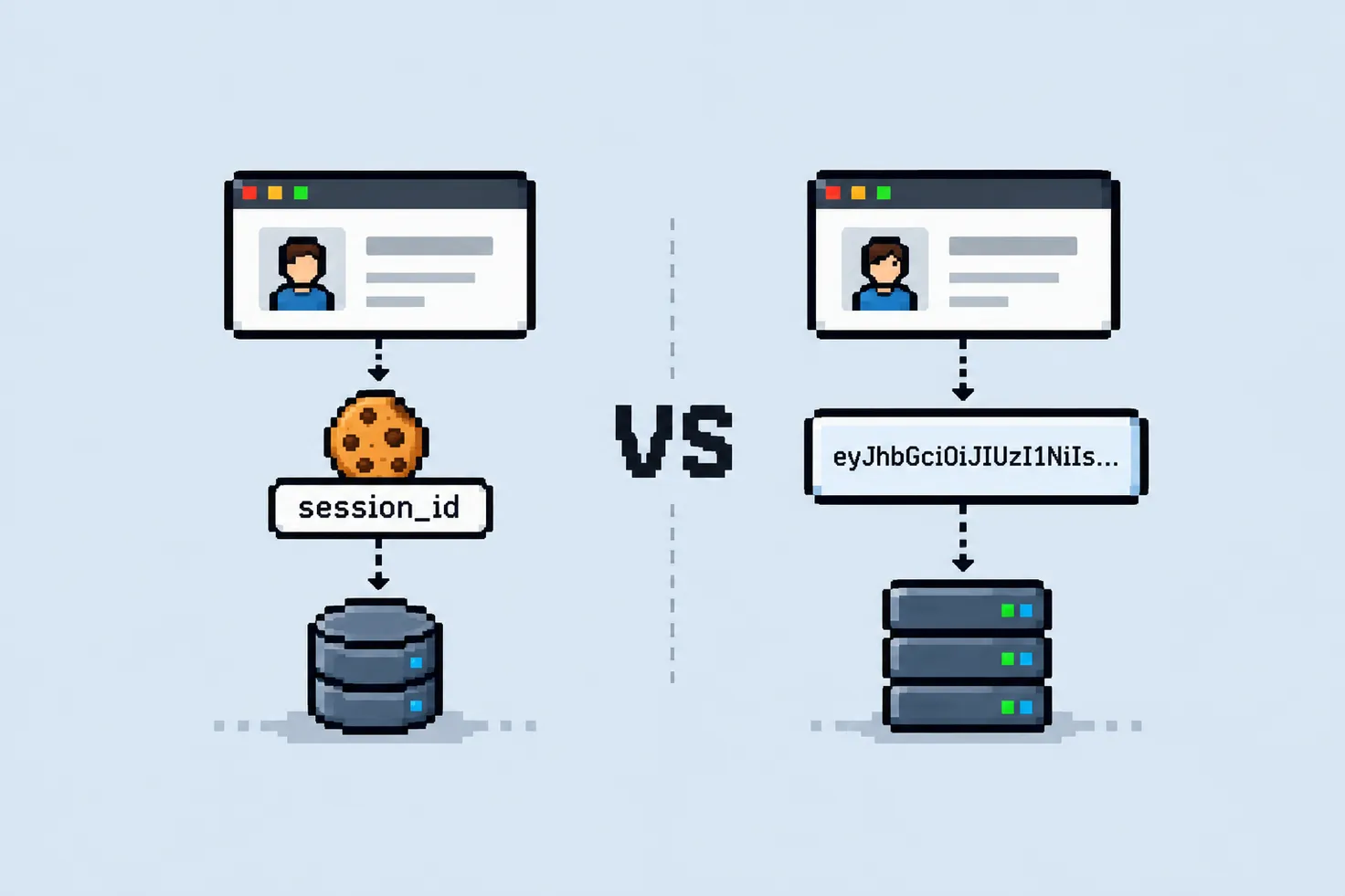
During curso.dev, I had my first hands-on experience with session-based authentication. Until then, I had already worked with JWT in other applications, but I had never implemented a stateful authentication strategy from end-to-end.
I decided to share a brief comparison of the two strategies, highlighting how they work, their strengths, and their trade-offs.
Session-Based Authentication
With session-based authentication, the user’s state is maintained on the backend.
How it works
- The user logs in.
- The backend creates and stores a session.
- A
session_idis sent to the client via a cookie. - On each request, the browser automatically sends this cookie.
- The backend looks up the session associated with the
session_idto validate the user.
This is a stateful model: the server needs to maintain state.
Advantages
- Easy to implement.
- Simple access revocation.
- A classic and widely used model for web applications.
Disadvantages
- It may require mechanisms such as Redis, a shared database, or sticky sessions to work efficiently across multiple instances.
JWT Authentication
With JWT-based authentication, there is no session stored on the server.
How it works
- The user logs in.
- The backend generates a signed JWT.
- The token is sent to the client.
- On each request, the client sends the token in the header:
Authorization: Bearer <token>- The backend validates the token’s signature, expiration, and claims.
It is considered a stateless model because the server does not need to store the session in order to validate the user. However, strategies such as refresh tokens and blacklists can reintroduce state on the backend.
Advantages
- Does not depend on backend session storage.
- Scales very well.
- Allows claims such as roles, tenants, permissions, and other information to be included in the token.
Disadvantages
- It often requires refresh tokens and/or blacklist strategies.
Conclusion
There is no perfect solution. Choosing between Session-based authentication and JWT depends on the context and requirements of the application.
Just as important as choosing the authentication strategy is handling sessions and tokens securely, including proper storage, appropriate expiration times, token rotation, and precautions to prevent credential leaks.